Wood engraving requires precision, stability, and reliable software compatibility. The following machines are among the best options for DIYers and professionals alike, offering strong engraving accuracy, ample working areas, and versatile materials support. Each entry includes key specs to help you compare power, speed, and usability at a glance.
| Product | Brand | Laser Power | Working Area | Highlights |
|---|---|---|---|---|
| ACMER S1 Laser Engraver (6000mW) | ACMER | 6000 mW | 130 x 130 mm | Ultra-fine accuracy, high speed, beginner-friendly |
| LONGER Ray5 (5W) | Longer | 5000 mW | 400 x 400 mm | High-speed, 0.08 mm spot, offline use |
| ACMER S1 (3500mW) | ACMER | 3500 mW | 130 x 130 mm | Good balance of power and precision, beginner-friendly |
| LONGER Ray5 (10000mW) | Longer | 10000 mW | 400 x 400 mm | High throughput, 0.06 mm spot, multi-attachment kit |
| Carverall K15 Pro (5W) | Carverall | 5000 mW | 200 x 300 mm | True 5W, broad material compatibility, easy setup |
Below are the five most relevant laser engravers for wood, selected for performance, versatility, and user experience. Each section includes an overview, key features, and practical considerations to help you choose the right model for your projects.
ACMER S1 Laser Engraver — 6000mW Power
The Acmer S1 6000mW model emphasizes high-precision engraving with a diode laser working at 455±5 nm and a 2 mm focal length. Its reported speed reaches up to 10,000 mm/min with 0.01 mm repeatable accuracy, supporting fine details on wood, acrylic, and other materials. A 130×130 mm working area keeps projects compact yet capable of nuanced designs. The unit ships 99% preassembled, enabling quick setup and a straightforward learning curve for beginners and professionals alike.
Key considerations include ensuring adequate ventilation for higher power use, and confirming compatible software/tools for macro-level designs. While powerful, the compact bed is best suited for small to mid-sized pieces, jewelry, plaques, and craft items rather than large panels.
LONGER Ray5 5W Engraver — 400x400mm

Ray5 5W delivers a generous 400×400 mm workspace, with a precise 0.08×0.08 mm laser spot and 0.01 mm engraving accuracy. It uses an ESP32-based processor for rapid processing and supports high-speed engraving up to 10,000 mm/min. The device accepts USB, Wi-Fi, TF card, and app connections, with offline operation for flexible workflows. A 3.5-inch touchscreen simplifies progress tracking and parameter adjustments. This model is ideal for crafting larger panels, signage, and more intricate projects that require a bigger bed.
Practical considerations include ensuring you have a suitable exhaust setup for fumes and selecting compatible software (LaserGRBL or LightBurn are common). Given the power and space, users can approach wood, acrylic, leather, and some metals with appropriate settings and materials handling.
ACMER S1 3500mW — Compact Yet Capable

This variant provides a balanced 3500mW diode laser with similar 455±5 nm wavelength and a 2 mm focal length. The 130×130 mm area remains suitable for small- to mid-sized projects with strong detail. The kit claims a quick setup with near-full preassembly, suitable for beginners who want quicker results without a steep learning curve, while still offering the capabilities needed for wood, acrylic, and light metal engraving and cutting tasks.
Consider whether you primarily work on small crafted pieces or need a compact desktop option. The 0.01 mm repeatable positioning accuracy supports fine line work, but users should be mindful of the slightly reduced power relative to the 6000mW model for deeper cuts on thicker materials.
LONGER Ray5 20W Engraver — 400x400mm

This model ramps up to 20,000 mW (20W) with a robust 400×400 mm bed and a 0.06 mm laser spot. It supports up to 0.01 mm engraving precision and offers multi-core processing with an ESP32-based chipset for simultaneous control of multiple devices. An included kit with air pump, rotary attachment, and risers expands capabilities for cylindrical objects and taller pieces. It is designed for professional-grade versatility in metal, wood, glass, and other materials, with strong potential for batch engraving and larger artworks.
Key factors include power consumption, heat management, and the need for reliable air assist for clean cuts. If your typical projects include rounding, deep engravings, or multi-piece builds, this model provides the scalability needed for more complex workflows.
Carverall K15 Pro — 5W For Beginners
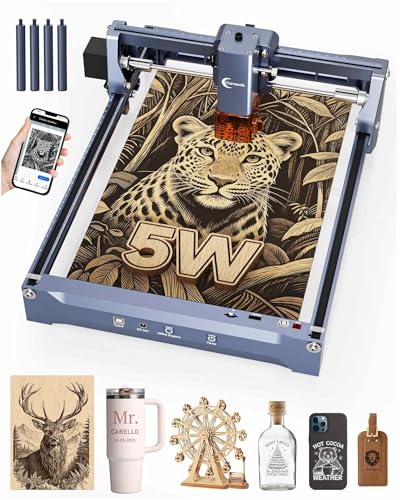
The Carverall K15 Pro is advertised with a true 5W output and a 200×300 mm bed. It aims to balance performance with ease of use, claiming sub-0.01 mm precision and a fast 15,000 mm/min engraving speed. It emphasizes compatibility with multiple software ecosystems, including CutLabX, LightBurn, and LaserGRBL, plus a ready-to-use package with safety glasses and starter materials. This combination is well-suited for beginners stepping into higher-detail wood engraving and light metal work on small to mid-sized pieces.
When evaluating suitability, consider software familiarity, the types of materials you plan to engrave, and the potential need for deeper cuts in dense woods. The 200×300 mm area supports plaques, plaques, signs, and small decor items, offering a reasonable workspace in a compact footprint.
Buying Guide: Key Purchase Considerations For Wood Engraving
Power and speed: Higher wattage typically enables deeper cuts and faster marking but requires better ventilation and more advanced cooling. For most hobbyists, 3.5W–6W covers a wide range of wood engraving tasks; 10W and above suit larger or denser materials.
Working area: A larger bed allows bigger designs but increases machine size and cost. Choose a bed size that matches your typical project scale, and consider expandability with jigs or attachments for cylindrical items.
Precision and repeatability: Look for laser spot sizes around 0.06–0.08 mm for fine detail and 0.01 mm repeatable positioning accuracy. Repeatability matters for multi-pass or multiple identical pieces.
Software and compatibility: Check whether the device supports common software such as LightBurn, LaserGRBL, or CutLabX. USB, Wi-Fi, and offline operation add workflow flexibility for studio setups and shop environments.
Safety and setup: Verify included safety glasses, proper enclosures, shielding, and air assist options. Preassembled units reduce setup time but ensure you can access maintenance and replacement parts easily.
Materials support: While most hobby-grade lasers handle wood well, check compatibility with acrylic, leather, PCB materials, and coatings. Some models perform better on certain substrates, so align features with your intended projects.
Upgrade path and attachments: Accessories like rotary rollers, air pumps, and risers extend capabilities to engraving cylindrical objects and thicker pieces. Consider future needs when choosing a base model.