When building models, dioramas, or displays, choosing the right styrene sheets can dramatically improve accuracy and ease of fabrication. This guide highlights five top-rated styrene sheets that American hobbyists and professionals commonly trust for scratch-building, detailing their sizes, thicknesses, and practical applications. Each option prioritizes durability, workability, and compatibility with common modeling techniques like cutting, sanding, and bonding.
| Product | Size | Thickness | Notes |
|---|---|---|---|
| LITKO 8×10 White (.020) Pack | 8×10 inches | 0.020 inch | Solid white, matte finish; ideal for terrain, bases, and dungeon walls |
| LITKO 8×10 Varity Pack | 8×10 inches | 0.020 inch | Multiple white options; versatile for various wall-like builds |
| LITKO 8×10 White (.080) 3 Pack | 8×10 inches | 0.080 inch | Thicker sheets for sturdier panels and larger structures |
| MEGA FORMAT White 9×12 5-Pack | 9×12 inches | 0.020 inch | Safe, durable, good dimensional stability for displays |
| MEGA FORMAT White 8×10 5-Pack | 8×10 inches | 0.020 inch | Affordable, versatile for framing and crafting projects |
Note: All products listed are suitable for modeling, crafting, scratch-building, and display work. Images and modeler-friendly features are drawn from typical listings and user applications.
LITKO 8×10-Inch White Polystyrene Flexible Sheets (.020 Inch) — Pack of 12

These 8×10-inch polystyrene sheets are solid white with a matte finish, providing a smooth surface ideal for scratch-building walls, bases, and terrain features. The .020 inch thickness offers flexibility for bending and shaping without sacrificing too much rigidity, making it a go-to choice for lightweight components. They’re easy to cut with hobby knives and suitable for sanding and painting to achieve in-scale textures. The matte white surface works well with acrylic paints and washes, enabling clean, uniform color application. Use for dungeon walls, miniatures’ bases, templates, or wall-like panels in dioramas.
Key advantages include good surface consistency, compatibility with most adhesives and cement glues, and straightforward handling for beginners and seasoned modelers alike. The sheets lend themselves to masked painting and precise scoring to create embossed textures or panel lines. While not the thickest option, this size and finish balance flexibility with reliability for a wide range of modeling tasks.
LITKO 8×10-Inch White Varity Pack — Polystyrene Sheets

The Varity Pack provides a selection of white, 8×10-inch polystyrene sheets with a matte finish. This pack is designed for modelers who want versatility in one purchase, allowing multiple projects that require different thicknesses or sheet conditions. The sheets are lightweight and easy to cut with standard hobby knives, while also accepting heat shaping for curved surfaces. They bond well with common plastics cement or solvent glues, enabling scratch-built components like walls, roofs, railings, and display-enhancing textures. The matte surface helps minimize glare during painting and reduces surface prep time.
LITKO 8×10-Inch White White (.080 Inch) Polystyrene Sheet — 3 Pack

These thicker sheets (.080 inch) provide added rigidity for structural components, large panels, or bases where warp resistance matters. The 8×10 inch footprint remains convenient for modular builds and rapid prototyping. The stiffer material holds edges well and accepts a range of finishes, including light sanding and scoring for detailed panel lines. With a matte finish and durable surface, they’re well-suited for diorama walls, vehicle panels, and shelf displays. They pair effectively with plastic cement or solvent-based adhesives and can be cut or shaped using standard modeling tools.
MEGA FORMAT White Polystyrene 9×12 Inch 5-Pack
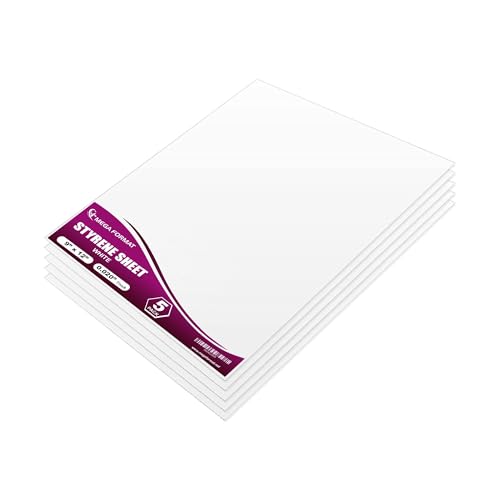
This 9×12 inch pack offers versatile white polystyrene sheets (.020 inch) that are widely used for displays, signage, and craft projects. The sheets demonstrate good dimensional stability, easy cutting and shaping with laser, jigsaw, or bandsaw as needed, and reliable bonding with common adhesives. Lightweight and shatter-resistant, they are ideal for framing projects, display backdrops, and scratch-built architecture. The broader sheet size allows for larger panels or multiple components from a single sheet, reducing waste in larger builds. They are well-suited for painting, airbrushing, and detailed textures without excessive substrate warping.
Buying Guide: Key Purchase Considerations For Styrene Sheets
- Thickness and rigidity: Choose thinner sheets (0.020 inch) for flexible walls or bases, mid-range (0.040–0.080 inch) for panels and structural elements, and thicker options for reinforced components.
- Surface finish: Matte white surfaces provide paint adhesion and reduced glare; glossy finishes can affect painting technique and texture outcomes.
- Size and yield: Match sheet dimensions to project scope. Smaller packs are ideal for modular builds and test pieces; larger sheets reduce wastage on bigger displays.
- Workability: Consider ease of cutting, sanding, and scoring. Some sheets respond better to scoring and snapping, while others work best with a rotary tool or laser cutter.
- Bonding compatibility: Ensure the sheet material is compatible with common modeling adhesives (cement, solvents, or cyanoacrylate) for clean joins and robust assemblies.
- Heat shaping and bending: For curved surfaces, select thinner sheets that bend more easily without cracking; heat-bending can help form complex shapes.
- Surface detailing: Embossed textures or the ability to scribe lines can influence the level of detailing achievable without specialized tools.
- Safety and handling: Polystyrene sheets are generally safe, non-toxic, and odorless, but use appropriate PPE when cutting or sanding to minimize dust.
- Project compatibility: Consider the scale and nature of your builds (dioramas, vehicles, bases, signage) to determine the ideal sheet thickness and size mix.
When selecting styrene sheets for modeling, aligning material properties with project requirements helps ensure precision, durability, and finish quality. The options above balance availability, ease of use, and versatility for typical modeling workflows in American hobby contexts.